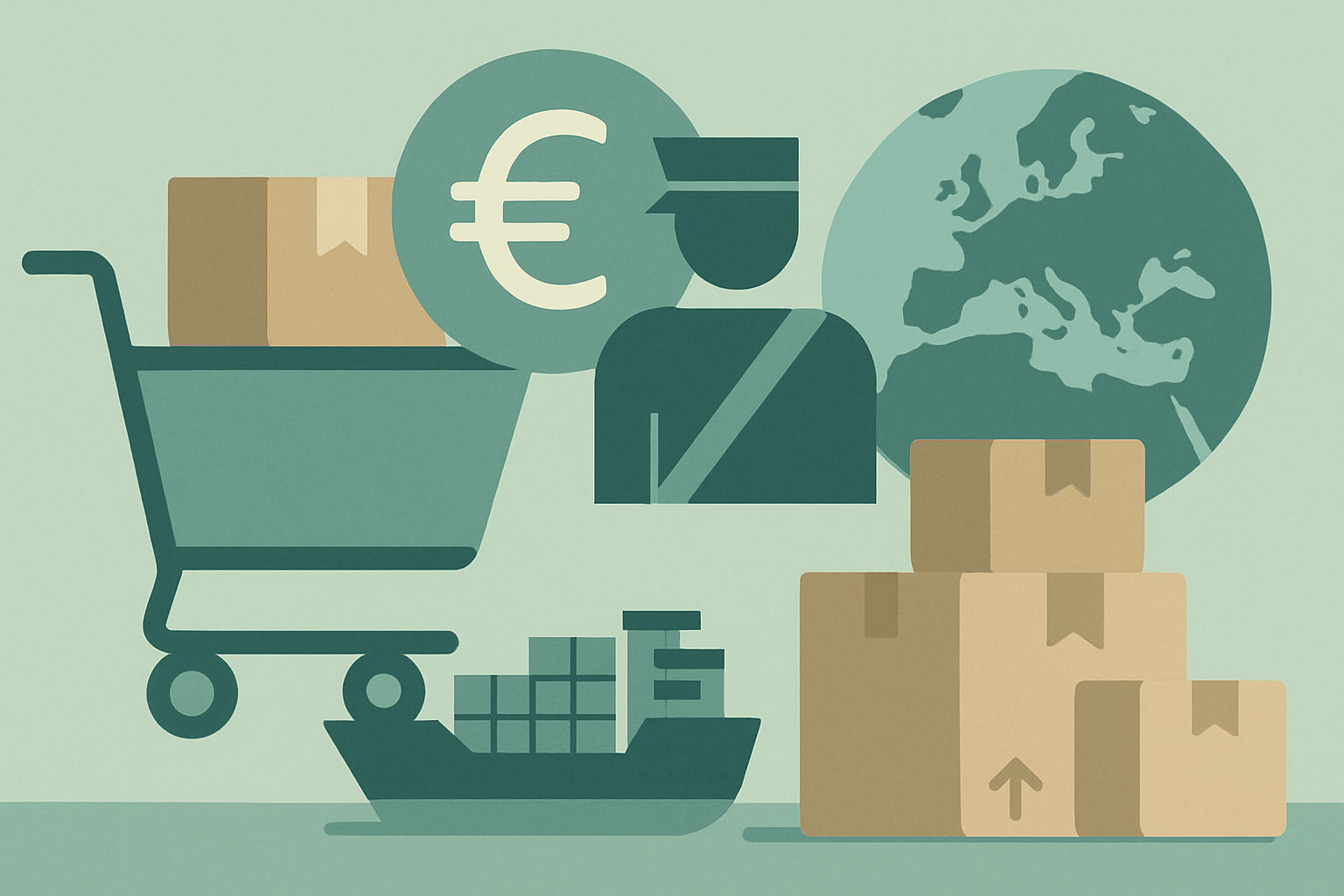
On July 1, 2026, the European Union closed one of the biggest loopholes in global e-commerce. For two decades, any parcel worth less than €150 could cross into the EU duty-free. Now every low-value parcel from outside the bloc gets hit with a flat €3 customs charge for each distinct item type it contains. A box with five identical t-shirts pays €3 once. A box with a t-shirt and a watch pays €6, because those are two different tariff lines.
Why This Rule Exists
The EU says the old exemption had turned into a structural subsidy for ultra-cheap, direct-from-China shipping. Regulators estimate roughly 5.9 billion low-value parcels entered the EU duty-free in 2025 alone — about 12 million a day, up from 1.4 billion just three years earlier. Meanwhile, EU retailers like H&M and Gap were paying full duties on every shipment. The new €3 charge is meant to level that playing field until 2028, when the EU’s planned Customs Data Hub takes over with a permanent tariff structure.
Shein and Temu Are Already Reacting
The fastest-moving evidence that this rule has teeth isn’t a government report — it’s what the platforms themselves are doing. Within days of the change, Google Shopping data showed Temu had cut its EU ad visibility roughly in half, and Shein appeared to be scaling back its European presence altogether rather than absorb the fee on millions of daily low-value orders. AliExpress, by contrast, increased its ad spend, betting it can compete without retreating. Whichever strategy wins, the message to shoppers is the same: the era of guaranteed rock-bottom, duty-free hauls from these platforms is over, at least inside the EU.
The Math That Actually Matters for You
Here’s the detail that gets lost in the headlines: a flat €3-per-item fee is regressive. It barely dents the price of something that already costs real money, but it can add 10% or more to a $5 phone case or a $8 t-shirt. That means the shoppers who feel this least are the ones buying fewer, better things — genuine electronics, name-brand cosmetics, real apparel from established retailers — rather than large hauls of ultra-cheap, disposable items with dozens of different SKUs per order.
That’s also true for parcels shipped from the US, which fall under the same sub-€150 rule when declared through the EU’s import scheme. If you’re using a US forwarding address to shop Amazon, Best Buy, Sephora, or a specific brand’s US site, your order usually has fewer distinct line items than a typical Shein or Temu haul, and the goods are worth more per item — so the flat fee is a smaller percentage of what you’re already paying. This is exactly the kind of shift where a service like Viabox, which gives you a real US address and consolidates purchases from multiple stores into one shipment, works in your favor: fewer separate parcels and more deliberate buying means less duty exposure overall, not more.
This Isn’t Just an EU Story
The EU is the biggest market to move this year, but it’s part of a broader pattern. Countries with historically tight de minimis thresholds — including several in the Gulf and Latin America — already tax most low-value imports in some form, and more markets are tightening rules rather than loosening them in 2026. The direction of travel everywhere is the same: fewer free passes for high-volume, low-value shipping, and more scrutiny on declared values and item counts.
What to Do About It
- Consolidate orders from multiple US stores into a single shipment where possible, to reduce the number of separate customs entries you generate.
- Favor fewer, higher-value purchases over large hauls of many cheap, different items — the flat per-line fee hits those hardest.
- Check whether your forwarder declares accurate, itemized values; the EU has explicitly flagged mis-valued declarations as part of what it’s cracking down on.
- Budget for the new fee on any sub-€150 shipment, whether it comes from China or the US, and treat it as a fixed cost of ordering internationally rather than a one-off surprise.
If you shop US stores regularly and ship abroad, this is a good moment to rethink how you consolidate and time your orders. That’s exactly what Viabox’s US address and package consolidation are built for — making sure your shipments are as efficient, and as duty-light, as possible.
Ready to put your US address to work? Log in to your Viabox dashboard to manage shipments and consolidate packages — or create your free US address in minutes.